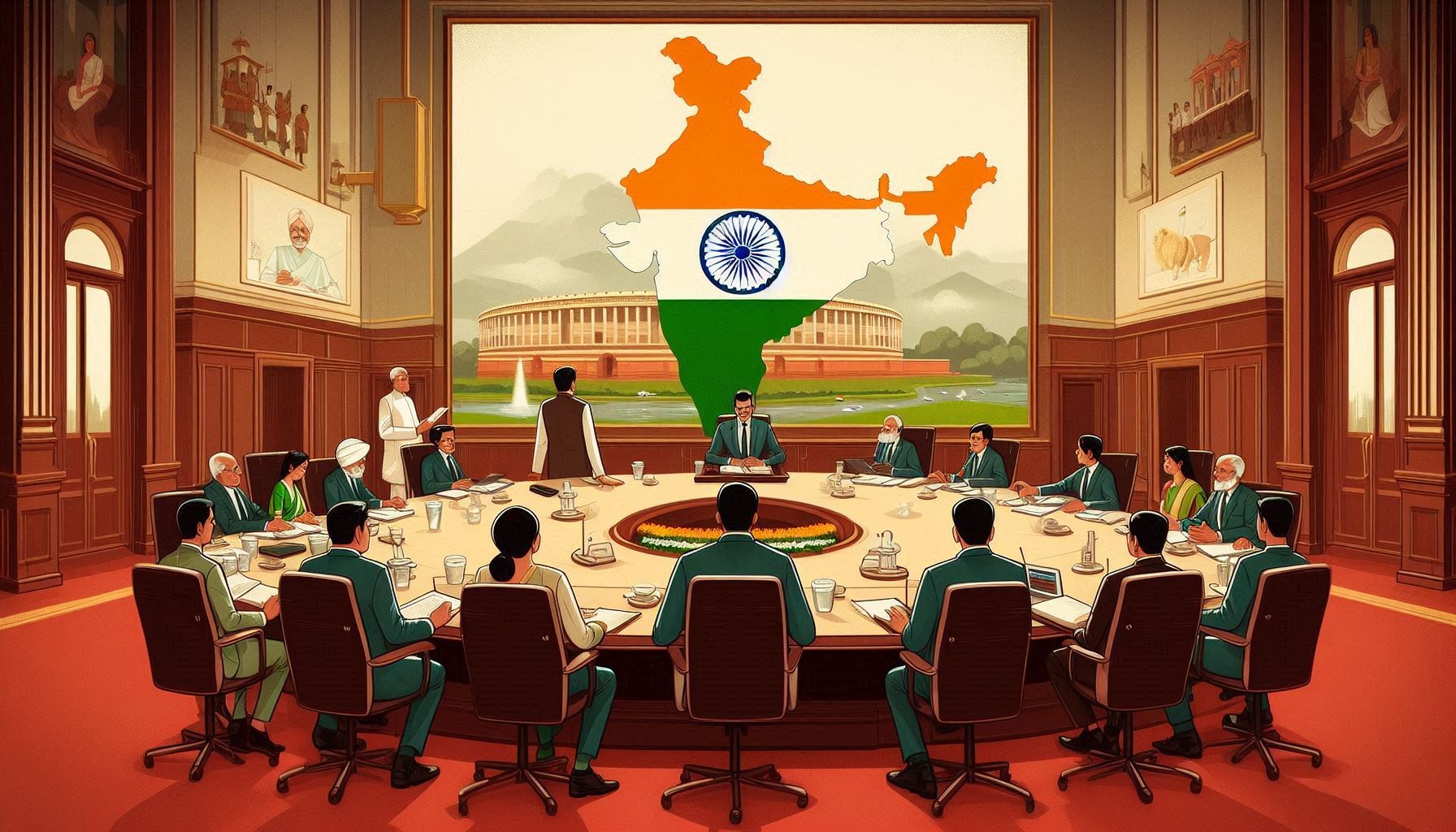
UPSC Indian Polity Module designed to cover the core concepts necessary for both the Preliminary exam (high weightage) and Mains (GS Paper II). It emphasizes the constitutional framework, its functioning, and the governance issues tied to current affairs.
Polity Module
UPSC Indian Polity Module designed to cover the core concepts necessary for both the Preliminary exam (high weightage) and Mains (GS Paper II). It emphasizes the constitutional framework, its functioning, and the governance issues tied to current affairs.
Phase I: The Constitutional Framework 📜
Focus: Understanding the foundational document, its sources, and its basic tenets.
1. Evolution and Salient Features
-
Historical Underpinnings: Regulating Act, 1773 to Indian Independence Act, 1947.
-
The Constituent Assembly: Composition, committees, and the process of drafting.
-
Preamble: Key terms (Sovereign, Socialist, Secular, Democratic, Republic, Justice, Liberty, Equality, Fraternity) and its amendability (referencing Kesavananda Bharati Case).
-
Salient Features: Parliamentary System, Federalism with Unitary Bias, Integrated Judiciary, Fundamental Rights (FRs), Directive Principles of State Policy (DPSPs).
-
Basic Structure Doctrine: Origin and list of elements included in the Basic Structure (e.g., Supremacy of Constitution, Judicial Review, Federalism).
2. Fundamental Trinity
-
Union & Territory (Part I): Articles 1-4; Process of formation of new states.
-
Citizenship (Part II): Modes of acquisition and loss; CAA/NRC controversies.
-
Fundamental Rights (Part III): Detailed study of Articles 14, 19, 21, 32; Judicial interpretations (e.g., Right to Privacy, Right to Education).
-
DPSP (Part IV) & Fundamental Duties (Part IV-A): Classification of DPSPs; Conflict and reconciliation between FRs and DPSPs (Minerva Mills Case).
Phase II: The System of Government 🏛️
Focus: Detailed structure, organization, and functioning of the Union and State Executives and Legislatures.
1. The Union Executive (President, VP, PM)
-
President: Election procedure, Powers (Executive, Legislative, Judicial, Pardoning Power-Art 72), Veto powers, Impeachment.
-
Vice-President: Role as Chairman of Rajya Sabha.
-
Prime Minister & Council of Ministers (COM): Role, responsibilities, and relationship with the President.
2. The Parliament (Union Legislature)
-
Composition & Functioning: Lok Sabha vs. Rajya Sabha (Special powers of Rajya Sabha).
-
Legislative Procedures: Types of Bills (Ordinary, Money Bill, Financial Bill, Constitutional Amendment Bill).
-
Parliamentary Devices: Question Hour, Zero Hour, Motions (No-Confidence, Censure), Budget process.
-
Anti-Defection Law (10th Schedule): Provisions and judicial interpretations.
3. State Government
-
Governor: Appointment, powers (including discretionary powers), and controversies (Bommai Case).
-
Chief Minister & COM: Parallel structure to the Union.
-
State Legislature: Unicameral vs. Bicameral (Creation/Abolition of Legislative Councils).
Phase III: Federalism & Decentralization 🤝
Focus: The dynamic relationships between different levels of governance.
1. Centre-State Relations
-
Three Lists (7th Schedule): Legislative, Administrative, and Financial relations.
-
Inter-State Relations: Inter-State Council, Zonal Councils, Inter-State Water Disputes.
-
Emergency Provisions (Part XVIII): National Emergency (Art 352), President's Rule (Art 356) and Financial Emergency (Art 360).
2. Local Self-Government
-
Panchayati Raj (73rd Amendment): Three-tier system; 11th Schedule (29 subjects).
-
Urban Local Bodies (74th Amendment): Types of urban governments; 12th Schedule (18 subjects).
-
Special Areas: 5th Schedule (Scheduled Areas) and 6th Schedule (Tribal Areas - Autonomous Districts).
3. Judiciary and Judicial Activism
-
Supreme Court: Composition, Independence, Jurisdiction (Original, Appellate, Advisory).
-
Judicial Review: Power to check constitutionality of laws.
-
Judicial Activism & PIL (Public Interest Litigation): Evolution and significance.
-
Judicial Appointments: Collegium System vs. NJAC Controversy (99th Amendment).
Phase IV: Constitutional and Statutory Bodies ⚖️
Focus: Structure, powers, functions, and removal procedures of key institutions.
-
Constitutional Bodies: Election Commission of India (Art 324), CAG (Art 148), UPSC, Finance Commission (Art 280), National Commissions for SCs/STs/OBCs.
-
Non-Constitutional Bodies: NITI Aayog, NHRC (National Human Rights Commission), Lokpal and Lokayukta, CVC (Central Vigilance Commission).
Phase V: Governance, Reforms & Current Affairs 📰
Focus: Linking static concepts to real-world administrative and political challenges.
-
Electoral Reforms: Issues of criminalization of politics, electoral funding, and recent proposals (One Nation, One Election).
-
Good Governance: Concepts of transparency, accountability, e-governance, and Citizen Charters.
-
Constitutional Amendments: Focus on major amendments (42nd, 44th, 52nd, 73rd, 74th, 86th, 97th, 101st, 102nd, 103rd, 104th, 105th) and recent bills/acts.
-
Social Justice: Welfare schemes for vulnerable sections; Role of the Civil Service.